Monday, August 29, 2011

Electric bus importer seeking loans from banks

Corporate News


Posted on August 28, 2011 09:57:19 PM

A FIRM planning to operate a fleet of electric buses has begun negotiating with banks to finance the importation of the vehicles into the country.


Green Frog Zero Emissions Transport will be tapping local banks for loans so it can bring in two buses before importing a second batch of 20 buses.

“Our buses will be arriving in batches. Our first batch of buses will be financed by a friendly forward-looking local private bank,” said Philip G. Apostol, managing director of Green Frog.

“[We are also] waiting for approval from PhilExim (Philippine Export-Import Credit Agency) for the loan guarantee for the next batch of buses,” Mr. Apostol added.

Together, “two banks will be tapped,” he explained.

He declined to specify the loan amount in the meantime, saying the firm is still negotiating with the bus supplier and the banks.

The company plans to import around 62 electric buses in four batches.

Of this, an initial 38 buses are planned to a portion of Makati City, mostly via Gil Puyat Ave.

The fleet is expected to be operational “before the end of 2012.”

The Energy department is pushing for the promotion of electric vehicles as part of its alternative fuels program for public transportation.

Already, the department has partnered with the Asian Development Bank (ADB) to provide electric tricycles to local government units.

The local government of Mandaluyong was the first city to be given electric tricycles.

Formally launched in 2008, Makati already has electric jeepneys servicing the city.

Power distributor Manila Electric Co. also expressed interest in putting up charging stations for electric vehicles.

Mr. Apostol went on to note that the company is importing the buses even in the absence of government incentives “that should jump-start the industry.”

“[The government] should help jump-start the industry by waiving import duties for CBUs (completely built up imported vehicles) and [providing] tax breaks for manufacturing,” he said.

Mr. Apostol said the manufacturing partner of Green Frog is “willing to discuss opening an assembly plant after local demand is proven.”

Green Frog is only one of the companies looking to roll out electric buses in the country.

Transportation firm Victory Liner, Inc. earlier announced its intention to run an initial 10 buses this year which will ply routes along the C-5 highway.

Victory Liner is also planning to build its own charging stations in its terminals so it can use electric buses for its provincial routes.

The firm has said, however, that its business plan will utimately depend on government’s direction.

The firm is seeking incentives to import its electric buses and have sought the help of the Climate Change Commission to provide suggestions for perks as each unit will cost the firm about P8 million to P8.5 million. -- Emilia Narni J. David

SM Supermalls steps up efforts to reduce usage of plastic bags

Posted on August 28, 2011 09:56:34 PM

THE MANAGEMENT behind SM Supermalls is looking to reduce the retail chain’s use of plastic bags and comply with local ordinances by stepping up efforts to sell reusable shopping carriers and offering incentives, an official said last week.


SM Shopping Centers Management Corp. plans to sell one million so-called eco bags by yearend or the first quarter of 2012, Raffy M. Maglalang, SM Center Pasig mall manager and a member of SM’s environment committee said at the project launch.


While plastic bag users will not be charged an additional amount, SM Advantage loyalty card holders who use the eco bag will be given loyalty points, which in turn can be converted to discounts or give-aways, among others.

We expect to sell more than last year because of the no-plastic bag ordinances in Pasig and Muntinlupa cities. More people will buy our eco bags. We expect our malls in those areas to follow the law and help reduce plastic bags,” Mr. Maglalang said.

In January, Muntinlupa City passed City Ordinance 10-109 to ban the use of plastic bags and polystyrene containers. In Pasig City, City Ordinance 09-2010 also banned the use of plastic and Styrofoam starting last month.

The retail giant also partnered with mall tenants Jollibee Foods Corp. and Goldilocks Bakeshop, Inc., to reduce plastic usage in their outlets. -- Franz Jonathan G. de la Fuente

Dutch treat to upland Negrenses: Flowing water

By DJ Yap
Philippine Daily Inquirer


His work had taken Dutch marine engineer Auke Idzenga to places that were literally high and dry, mainly the uplands of Negros. When he first got there in the late 1990s, the closest water source was hundreds of meters away from the poor villages, often requiring a trek down treacherous ravines.

But Idzenga had since led a group that not only overcame gravity but also cynicism and racial divides.

The group equipped the mountain settlements with the hydraulic ram pump, an old, nearly forgotten technology capable of bringing a steady water supply to elevated areas using only the raw power of a rushing river or stream.

Everywhere he went at the beginning of his mission, the tall and lanky Caucasian often drew curious stares from the villagers.

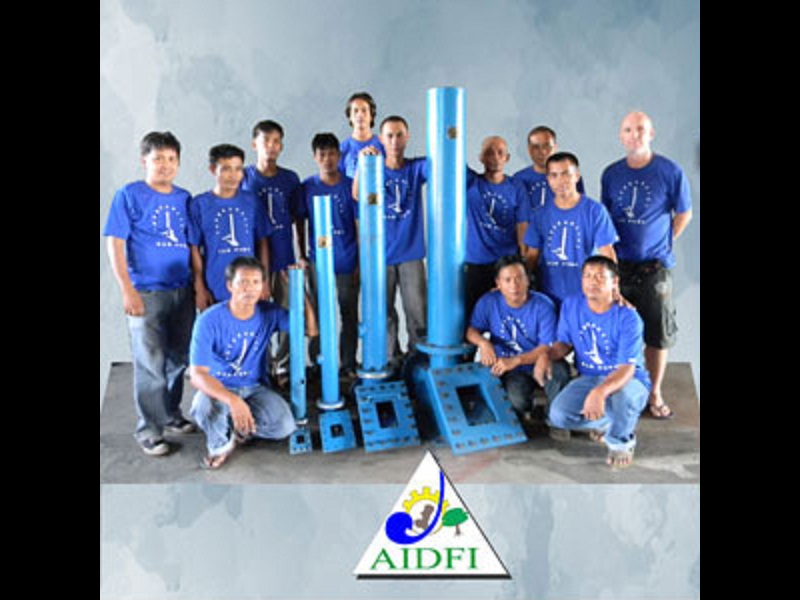
“But when I began talking in Ilonggo, I blended in immediately,” said Idzenga, co-founder of the Philippine-based Alternative Indigenous Development Foundation Inc. (AIDFI), one of this year’s recipients of the Ramon Magsaysay Award.

Considered the Asian equivalent of the Nobel Prize, the award is being given to AIDFI (the lone recipient from the Philippines this year), as well as to five individual honorees from Indonesia, India, and Cambodia. The awarding ceremony is set on August 31 at the Cultural Center of the Philippines.

Filipino at heart

He hailed from Holland, but the 49-year-old Idzenga said he had become a Filipino at heart, more so after he married Susan, a Negrense. Like him, their four children speak fluent Ilonggo; “no Dutch or English” spoken in their Bacolod home, he said.

“When I talk, I don’t look at myself and I don’t see my kulay (skin color),” Idzenga said. “I look at myself as an internationalist, but my heart is with the Filipinos.”

AIDFI’s development work has so far centered on promoting the ram pump, but Idzenga and the group’s 20 full-time Filipino members are also developing other self-sustaining technologies, such as one that processes lemon grass into essential oils.

AIDFI was formed in 1991 by a group of activists led by union organizer Leonidas Baterna, who shared his dreams of an “integral and liberating development” with Idzenga.
Their partnership was forged against a backdrop of social turmoil that accompanied the collapse of the sugar industry in Negros in the 1980s. Hundreds of workers and farmers were then displaced, their families sinking deeper into poverty and hunger.

Distrust, suspicion


AIDFI sought to address the basic needs of the affected farmers through agricultural production and technology development. But lack of funds and the loss of key members forced the organization to close shop after only a few years.

Idzenga said this was partly due to the distrust and suspicion among the upland villagers toward non-governmental organizations (NGOs) like AIDFI.

We had to work really hard for funding because of the bad name NGOs got especially in Negros. In the 1980s when the programs were not implemented well, there were so many NGOs that mushroomed,” he said. “We worked without funding for many years. And there was no government support.”

At that point, returning from a brief visit to his native Holland, Idzenga worked to revive AIDFI, this time giving the group a much clearer focus on rural technology. He came up with his own design of the ram pump and had it patented.

The ram pump uses the natural kinetic energy of flowing water from rivers or springs to push water uphill, without relying on gas or electricity.

The “reinvented” pump introduced by the AIFPI to the Negros uplands can bring water to an elevated  reservoir at 1,500 to 72,000 liters per day, according to Idzenga.


Social package

The pump itself accounts for only 10 percent of the cost of the entire “social package” the group brings to the community that would avail itself of the technology.

The package also includes community consultation and technical training, ownership transfer, and the setup of local associations that would manage the water generation and distribution system, as well as financing.

AIDFI also receives donations or grants from businesses, banks and the government, Idzenga said. For example, “we’re talking with Coca-Cola about producing 50 ram pumps a year and they would be paying for them,” he said.

Landbank is now picking up the technology and offering it to municipalities through loans. We also get some money from the Department of Agriculture for research,” he added.

While most of its projects are in Negros, up to 180 AIDFI initiatives have taken root across the Philippines. The group also managed to set up projects in Cambodia, Afghanistan, Nepal, Malaysia, East Timor, Costa Rica, Peru and even First World countries like Japan and France.

Idzenga said the introduction of the ram pump often became the “triggering point” for development in the  communities, like in the case of Sitio Anangue in Murcia, Negros Occidental.

The small village remained poor despite being placed under land reform in the 1980s, he recalled. “The road was very bad. It was very hard for the villagers to cultivate the land. There were no facilities and the community was not organized. They were very much like on survival mode; it was just everybody for himself and there was occasional conflict.”


Organized for first time

“Then we came in with the ram pump,” Idzenga said. “It was the first time the community had any organization of any sort. We completely organized the water association.”

“Then from one village, we got a request from the neighboring village. Then there was a third. So it became three sitios. There’s more cooperation because water came from the same place,” he said.

And soon, the water association in Anangue started exploring other development projects, he said. With the households paying P30 per month for the water, the community found itself with enough funds to go into hog raising and cash crops.

“In the past, this kind of thing never happened in the community. Now they have started cooperating. Now they start thinking of further development,” he said.

City dwellers tend to take water for granted, he said. But in the uplands, “you have to imagine how the people have to go down 80 meters (to fetch water), every day. Try it yourself and carry 40 liters of water on your back.”

“Sometimes kids missed classes because whenever their parents went down to fetch water, the kids would just end up playing and forget about school,” Idzenga said.

Affectionate people

Idzenga said he was drawn to the Philippines as a young man of 22, after hearing many stories about the country when he was still working as a seafarer.

After two decades of living in the Philippines with his family, he said, “I don’t know the difference anymore between living here and in Holland. Everything here is normal for me now.”

Filipinos, Idzenga said, are an affectionate people. “The first thing they do is look at the color (of my skin), but then when we start talking, they warm up and connect. They keep on coming back to talk. It becomes a friendship. Very warm.”

Because of this connection, he said, he had taken great pride in improving the lives of the country’s poorest, especially in places hardly reached by government services.

The fact that we can bring up water at such volumes for every family, and they don’t have to go down the mountain anymore, that’s a huge, unbelievable transformation,” Idzenga said.

The Ramon Magsaysay Award, Idzenga said, would give his organization a bigger voice for its advocacy.  “It fits in our highest objective, which is to spread the (ram pump) technology all over the world. Winning this award will help us reach more villages,” he said.

Monday, August 1, 2011

PCCI hits focus on renewable energy

Says PH needs baseload plants, lower power rates

By:


PCCI: Bring electricity prices down first before burdening consumers again with FIT rates for renewable energy projects.

The government should find ways to drive current electricity prices down before introducing another burden to consumers and industries through the feed-in tariff (FIT) rates for renewable energy projects, the influential Philippine Chamber of Commerce and Industry said.

PCCI energy committee chairman Jose Alejandro said power rates were expected to increase even more next year due to the expiration of the transition supply contracts (TSCs) attached to the privatized plants and independent power producer (IPP) contracts of National Power Corp.

“Can we expect that the new contracts that will be negotiated will have lower rates than the old TSCs? Of course not. We expect the new rates to be higher,” Alejandro said in an interview Friday.

These would be further exacerbated by petitions by Power Sector Assets and Liabilities Management Corp. for the universal charge, as well as the generation rate adjustment mechanism (GRAM) and the incremental currency exchange rate adjustment (Icera), automatic adjustments that could move rates either up or down.

The introduction of the FIT rates for renewable energy projects would add another burden to consumers and businesses, Alejandro said, making the country even less competitive on the global stage.

We’re already charging too high for power. It would have been okay if we were just one or two centavos higher than our neighbors, but our rates are double or even triple those of other countries in the region. We can’t have any more increases,” Alejandro said, referring mainly to the FIT rates.

The FIT scheme assures renewable energy developers of future cash flow as electricity end-users will be charged fixed amounts to cover the production of energy from renewable sources.

Payment for the use of clean energy will come from a uniform per-kilowatt-hour charge, dubbed FIT Allowance (FIT-All), which will be collected from all electricity end-users.

The National Renewable Energy Board recently approved a FIT rate of 12.75 centavos a kWh for renewable energy projects. This universal levy would be borne by all power users by 2014, when all expected renewable energy projects would have already gone on line.

Instead of pushing to get renewable energy projects on line, Alejandro said the government should focus on getting more commitments for additional baseload generation capacity.

At this point, Alejandro said, the country already had enough renewable energy capacity from its numerous hydro and geothermal installations. Some projects such as biomass and mini-hydro could be installed in off-grid areas. Solar and wind, however, should take a backseat—at least for the next three to five years.

Our priority should be building baseload and reserve capacity and bringing power rates down. We need sustainable, reliable power supply. We don’t need [renewable energy] now. It’s not reliable, it’s not controllable, and it’s very costly,” Alejandro said.

“It will be counterproductive for the country to focus on [renewable energy]. Let the technologies mature first, but in other countries, not here. We can still catch up, especially when the technologies become much cheaper to install,” Alejandro added.

Wednesday, July 27, 2011

Philippine-made batteries propel solar-powered vessel

By:
MANILA, Philippines—The world’s largest and most advanced solar-powered boat, the M/S Tûranor Planet Solar, is proof that energy harnessed from the heat of the sun can power practically everything—from pocket-sized calculators to cruise ships.

M/S Tûranor Planet Solar has finally arrived in Manila, not only showcasing the potential of environmentally responsible mobility concepts, but also largely demonstrating the immense potential of solar energy, among other renewable energy sources, as a sustainable resource that can power the future.

“The sun has always been our planet’s most important source of power—wind, rainfall and waves—are all indirectly generated by the sun. Harnessing even a tiny portion of its immense power can provide us with limitless amounts of clean energy,” said World Wide Fund for Nature (WWF-Philippines) chair Vincent Pérez  in a statement.

“The message of M/S Tûranor Planet Solar is clear: clean and dependable renewable energy technology is here,” added Pérez, who served as Philippine energy secretary from 2001 to 2005 and has since been active in promoting renewable energy.

The German-built vessel measures 31 by 15 meters and tips the scales at 85 tons. Over 537 square meters of photovoltaic solar panels provide up to 127 horsepower – enough to keep the craft moving at a constant speed of 14 kilometers per hour.

The ship is exclusively powered by 38,000 high-efficiency solar cells all produced in the Philippines at the manufacturing facilities of SunPower Corp. Already, it has won two accolades – the fastest crossing of the Atlantic by a solar-powered vessel and the longest distance covered by a solar-powered electric vehicle, according to WWF.

The catamaran now targets to be the first solar-powered boat to circumnavigate the world. Traveling over 55,000 kilometers westward across the Atlantic, Pacific and Indian Oceans, the M/S Tûranor set sail from Monaco in southern France on September 27, 2010 and has just arrived in Manila from Australia.

WWF claimed that the Philippine stop was recognition of the country’s strong support for renewable energy.

Over the next 20 years, the Philippine government, through the Department of Energy, targets to increase the use of renewable energy by threefold as clean energy is now being seen as a another way to secure the country’s energy supply.

Specifically, the Philippines will target to increase renewable energy-based power capacity to over 15,200 megawatts in installed capacity. This target will allow the country to have a power mix in which RE resources will account for over 50 percent. As of end 2010, total RE generation stood at 26.3 percent.

These goals set under the National Renewable Energy Program can be achieved given that the country has abundant renewable energy sources, with various estimates ranging from 200,000 MW to as high as 276,000 MW in potential capacity. These resources included biomass, geothermal, solar, hydro, ocean and wind.

Thursday, July 7, 2011

Pay for renewable energy now, reap benefits later, execs say

By:


Power consumers should bear the additional cost of renewable energy now to ensure that the country reaps the benefits of clean power in the long term, ranking energy industry executives said.

According to Shell Companies in the Philippines country chairman Edgar Chua, RE project subsidies should be treated as more of an “insurance premium,” which consumers would be front loading to be able to enjoy future benefits.

Think of it as a hedge for the future. RE is an area where the Philippines can do well,” Chua said.

He said global energy demand would double by 2050, which meant that demand for increasingly scarce fossil fuels would also skyrocket. Energy prices would spike if no alternatives would be presented.

By 2050, Chua said RE would account for 30 percent of the world energy mix, and the Philippines had the opportunity now to build on its future RE capacity.

First Gen Corp. vice president Al Santos said consumers should be willing to pay for RE technology now instead of waiting until the technologies mature and prices fall.

It takes time to develop local capacity and capability. Also, in three to five years’ time, the (difference between current grid rates and RE rates) will be zero or almost zero. So why do we have to wait? If we pursue RE projects now, by the time we reach grid parity, we’ll have the local capability to install the various RE technologies,” he said.

Business groups and the Department of Trade and Industry had expressed concern over the Department of Energy’s thrust to boost the country’s RE capacity, as this would entail subsidies that would further jack up already-high electricity prices.

In an earlier interview, Trade Secretary Gregory Domingo said the Energy Regulatory Commission, in coming out with the final feed-in tariff (FIT) rates for RE projects, should take into consideration the country’s global competitiveness.

The FIT scheme assures RE developers of future cash flows, as electricity end-users will be charged fixed amounts to cover the production of energy from renewable sources. With this in place, utilities can spread the cost of clean power among its customers.

Payment for the use of clean energy will come from a uniform per-kilowatt-hour charge, dubbed Feed-in Tariff Allowance (FIT-All), which will be collected from all electricity end-users. These collections will go into a National Grid Corp. of the Philippines-administered fund from which payments to RE developers will be taken.

Saturday, May 21, 2011

14 points to ponder for a solar home

By:


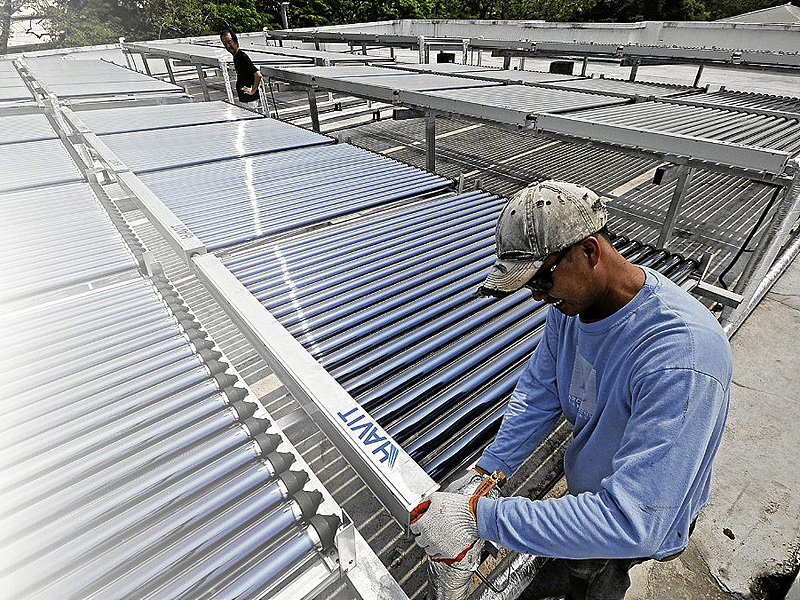
A MAINTENANCE crew puts finishing touches on a solar panel installed on the rooftop of St. Augustine building in La Consolacion College Manila, Mendiola. ANDREW TADALAN

YOU’RE FROM the Philippines where it’s sunny every day.” That line, as “Glee” fans would have known by heart by now, was uttered by Lea Michele’s character Rachel Berry to Charice Pempengco’s Sunshine Corazon.

That line, of course, is loaded with brightly positive meanings. Though we often view such sunny days as being too hot and sweaty for comfort (especially during summer when the mercury hits the high 30s), to energy conservationists that is a complete blessing.

Inquirer Property has featured these environment-conscious homeowners who have reaped the benefits of the sun’s eternal energy. There’s environment scientist Kelvin Rodolfo and his geriatric-friendly solar-powered 200-square-meter home in Wisconsin (Inquirer Property May 17, 2008 issue), and businessman Ferdie Raquelsantos, who has installed six solar panels and a wind turbine on his roof, generating an equivalent of 1,200 and 900 watts, respectively, of free electricity for his 530-sq-m home in Ayala-Alabang. He now heads Solar and Wind Electric Power Inc. (Inquirer Property Nov. 27, 2010 issue)

Here’s why you should also consider installing solar panels for your own homes:

1 Solar panels reduce your carbon footprint and lower energy bills. Solar energy is harnessed through photovoltaic, or solar, panels that turn light into electricity, explains Kim McKay and Jenny Bonnin, authors of “True Green (100 everyday ways you can contribute to a healthier planet).”

2 Solar power is ideal for structures with high energy demands. Diane Gow McDilda, author of “365 Ways to Live Green,” said many municipalities have installed solar power systems at locations with high energy demands, such as schools and municipal administration buildings. In the Philippines, for instance, the agricultural town of San Manuel installed a solar panel and battery in front of its public cemetery and used that to light its streets and the Doña Carmen Park in the town plaza. The island barangay of Pang-an in Lapu Lapu City has a solar complex at the center comprised of 504 panels generating 90 watts each.

Consider your own household’s power consumption. If it’s big enough (your electricity bill runs above P5,000 a month), then invest in solar panels. A minimum setup of a high-quality solar power system (complete with inverter and electrical wiring) that can generate 1,300 watts of power enough to run a 150 to 200-watt ref, about three 60-watt electric fans, a 150 to 200-watt LCD TV, a 150-watt washing machine and a 600-watt iron, could cost a steep P700,000. A bit pricey, but that could guarantee an instant drop in electric bills, a return on investment after 9 years, and ultimately, up to 40 years of worry-free operations.

Raquelsantos’ setup, for instance, is built to last for that long. He guarantees the system to be 100-percent efficient for 25 years, dropping to 90 percent efficiency on its 40th year.

He cautions would-be users, however, that there are certain power losses even in a properly set up solar panel system. A set that can generate 1,300 watts would, in reality, have a usable energy output of 70 percent (910 watts) only.

The minimum setup for a “grid-tie” system of 1,300 watts (grid-tie means the household is still dependent on a power provider like Meralco) would save homeowners around P3,000 a month in electricity, if they are not enrolled with Meralco’s Time of Use (TOU).

3If you are off-grid (meaning there is no power provider in your area), then a battery system package is what you need. A typical caretaker’s hut in a farm would need two batteries and two 220-watt solar panels, which would cost around P190,000, Raquelsantos estimates.

A smallest package of off-grid battery system—used for storing power that could be used at night especially in farms and provinces—would cost about P20,000. A typical off-grid battery system can power a TV set, electric fan and several lights, and charge a cellphone simultaneously.

4Solar power technology is still in its infancy. And as such, equipment and installation is still more expensive than using traditional fossil fuel options. However, as more private and public power plants are set up and solar cell technology advances, the cost to generate and store solar power is expected to decrease.

5If you choose to use solar panel technology in your home, apply for time-of-use (TOU) with Meralco and slash about 15 percent from your bill, Raquelsantos suggested. Registering for TOU means that when you consume power between 8 a.m. and 9 p.m., you would be charged a higher rate. When you use power between 9 p.m. and 9 a.m. (typically the off-peak hours), you will be charged lower. You can use solar power during the peak hours. At these times, you can do the activities that use up much power, such as run the washing machine, ironing, etc. so you can maximize whatever energy you harvest from your solar power system.

Solar maintenance
6As effective maintenance, clean the panels twice a year to improve their collection of the sun’s rays. Cut away tree branches that may shade the panels.

If your system has batteries, check the level of electrolytes once a month and make sure clamps on the terminals are tight. Other than this, you practically just leave the system as is, as the inverter and charger requires no maintenance.

(Have you discovered a “sunny” solution to your energy needs? We’d like to know. E-mail the author at tsalazar@inquirer.com.ph)

Friday, May 6, 2011

Senator seeks tax incentives for electric vehicles

KIMBERLY JANE T. TAN, GMA News
05/05/2011 | 07:27 PM

Senator Ralph Recto on Thursday said that the country should shift to electric vehicles to end its overdependence on oil products, whose prices keep rising.

“With soaring oil prices and with a downstream oil industry that can’t be trusted with its price hike computations, there’s really no recourse but to go electric to save oil money and save the environment," Recto, chairman of the Senate Committee on Ways and Means, said in a statement released Thursday.

He said that his committee will soon report out to the Senate plenary a consolidated measure that would give tax incentives to people or groups who will import, convert, manufacture or assemble the pioneering fleet of electric vehicles in the country, including hybrid and other motor vehicles using alternative fuel.

Recto explained that an electric vehicle may refer to any vehicle that uses electric motors, while a hybrid vehicle may refer to any vehicle that combines the use of internal combustion engine with a battery-powered motor.

“Other countries like Israel and China are already declaring freedom from petroleum dependence in the next three or four decades, we want to start the ball rolling by paving the way for a legislation that would fast track our shift to e-vehicles," he said.

Recto explained that e-vehicle proponents shall be exempted from paying the Motor Vehicle User's Charge, excise taxes, and VAT for nine years to bring down the cost of importing and converting e-vehicles and their hybrid types, in the process also lowering the price for consumers.

On the other hand, the "non-tax" incentives shall include their non-inclusion in number or color coding, a special priority lane, and mandatory parking facilities in future commercial and public establishments.

If the draft measure is approved, he said that the Land Transportation Office would also be required to issue special license plates to e-vehicles. He added that business owners whose establishments do not have areas designated to e-vehicles will not be issued building permits.

Recto said that his co-authors in the consolidated measure are Senators Juan Miguel Zubiri (Senate Bill 1445), Miriam Defensor-Santiago (SB 2460 and 2529), and Antonio Trillanes IV (SB 2598), who have filed similar measures on the matter.

Recto, for his part, filed SB 2536. — TJD, GMA News

Friday, April 29, 2011

Palace prioritizing program for electric PUVs

04/27/2011 | 08:20 AM

In the wake of continued increases in prices of fuel, the government has started taking steps to wean public utility vehicles from fossil fuels, Malacañang said Wednesday.

Presidential Communications Operations Office head Herminio Coloma Jr. said the Departments of Energy and Transportation and Communications have made the first step with tricycles.

“Yan ay priority measure, 'di maaring magpatuloy ang kasalukuyang sitwasyon na masyado tayong naliligalig sa pagkaroon ng volatility of oil price movement," he said in an interview on dzXL radio.

He noted they are starting the program with some one million public utility tricycles in the country.

The government will use a grant from the Asian Development Bank for this, he said.

“Ang unang programa natin, ang pinaka-basic transportation na ginagamit, ang tricycle. Ang objective natin alisin totally ang dependence ng tricycle sa oil at magkaroon ng electric tricycles," he said.

Coloma said that once this is completed, the Department of Energy (DOE) and the Department of Transportation and Communications (DOTC) will set their sights on other public utility vehicles such as jeeps and buses.

Many buses already use other forms of energy such as compressed natural gas (CNG) while some taxis and jeeps have been modified to use liquefied petroleum gas (LPG).

“As for other forms of public transport, the DOTC and DOE are firming up specific measures," he said.

Power sector slightly affected

Meanwhile, Coloma noted the energy situation was not too affected by the rising prices of oil since only nine percent of electric power is sourced from fossil fuel.

He said only nine percent of electric power is generated through fossil fuel and the 91 percent is sourced from geothermal, hydroelectric and coal.

“Di tayo masyadong apektado, 9 percent lang ang fuel-related," he said. — LBG, GMA News

Gov't mulls converting jeepneys to LPG

04/15/2011 | 02:45 PM

The rising fuel prices caused by the flaring unrest in the Middle East have put Philippine government officials on the edge because of the specter of higher costs of transport and commodities.

To cushion the effects of the price increases on ordinary Filipinos, the transport sector has begun to promote alternative fuel sources for public transportation that would make the country less dependent on fossil fuels.

According to government officials from the environment and energy departments, the Philippines has to be more aggressive in using greener transportation technologies and alternative fuels to make it less sensitive to the volatility of the crude oil market, which is reaching record high levels due to the recent instability in Egypt, Libya, and Yemen. Demand for oil is also expected to go up because of the recent natural catastrophes in Japan.

MOU with jeepney operators

The Department of Energy (DoE) and various jeepney operators have signed a memorandum of understanding to encourage jeepneys to switch to auto liquefied petroleum gas or compressed natural gas (CNG) engines from diesel-run machines.

By diversifying the country's fuel sources, the country will be less reliant on imported oil and petroleum products, the DoE said.

According to the DoE, auto LPG systems turned out to be more cost-efficient, as seen in the examples of taxis. They are also cleaner than diesel or gasoline, the DoE said.

“As of March 17, 2011, pump prices for diesel hovered between P40.25/liter to P42.55/liter, and gasoline was priced between P48.50 and P50.30 per liter compared with auto-LPG which was priced only between P27.74 and P30.12 per liter," the DoE said.

CNG is priced even lower. There are currently 12,000 auto LPG converted vehicles nationwide. On the other hand, the country’s first foray toward the utilization of CNG was through the Natural Gas Vehicle Program for Public Transport (NGVPPT) of the government.

Those who signed the March 2011 MoU with the DoE were Liga ng Transportasyon at Operator sa Pilipinas (LTOP), Makati Jeepeney Operators and Drivers Association (MJODA), Public Transport Workers Foundation (PTWF), Alliance of Concerned Transport Organizations (ACTO), Federation of Jeepney Operators and Drivers Association of the Philippines (FEJODAP), Pasang Masda, Alliance of Transport Operators and Drivers Association of the Philippines (ALTODAP), and United Transport Coalition (1-UTAK).

Support from Congress

Senator Edgardo J. Angara, chair of the Congressional Commission on Science and Technology (COMSTE), expressed support for the eco-jeepney program, saying it complements COMSTE's promotion of alternative fuels for the transport sector.

“The Philippines is one of the most oil-dependent countries in Asia. This puts us in a vulnerable position as the country’s demand for energy can only be expected to grow as households, transport and factories multiply," Angara said.

Citing COMSTE data, Angara said the Philippines imports 94 percent of all its crude oil needs. The country's oil consumption is expected to rise by 10 percent in the next decade.

COMSTE urged the government and private sectors to look into the mainstreaming of alternative fuels such as biofuels and the development of new technology that can produce more efficient, low cost batteries and new electric vehicle design initiatives.

"The future is in clean, renewable energy, which is predicted to be one of the biggest industries by 2014. It is a vital step we must take in order to harness and develop the abundant alternative energy resources that our country possesses, to benefit both present and future generations," Angara added.

Gov't also eyeing electric tricycles

One of the alternative vehicles that the government is currently promoting is the electric tricycles. According to Juan Miguel Cuna, director of the Environmental Management Bureau (EMB) of the Department of Environment and Natural Resources, some 30 e-trikes from the Asian Development Bank have been given to areas like Mandaluyong City last year as part of the agency's program to make the country's transport sector more efficient and cleaner.

In a statement this week, the ADB said it has completed the Phase One of the E-trikes project, where they donated some 30 e-trikes to various cities.

As part of the pilot project, ADB said it will put four charging stations in Mandaluyong City, which will be able to charge the e-trike batteries to 50% capacity in less than 30 minutes. One of the charging stations will use solar energy.

The DENR and the ADB said the e-trikes are less noisy than the diesel-run tricycles. They are also cleaner and will lower the country's carbon emissions.

80% of Manila air pollution from cars

According to the DENR and the ADB, emissions from the transport sector currently represent 30% of all pollution in the country, and approximately 80% of air pollution in Metro Manila.

A significant proportion of vehicle emissions are attributable to inefficient public transport, particularly from tricycles, jeepneys and buses, the ADB said.

“Working together, we can give Manila cleaner air, bluer skies, and a more livable environment," said Kunio Senga, Director General of ADB's Southeast Asia Department.

"The Philippines is assuming a leading role in Asia in supporting green transportation alternatives, and if e-trikes are followed by new fleets of electric buses and jeepneys, the effect could be transformative."

According to the ADB, over 3.5 million motorized tricycles are currently operating in the Philippines, producing more than 10 million tons of carbon dioxide and using close to $5 billion of imported fuel each year.

Motorized tricycles - which are motorcycles with sidecars - are popularly used as low-cost public transport for short distances.

Millions of dollars in fuel savings

"Every 20,000 e-trikes that are introduced to Manila's streets will save the Philippines 100,000 liters of foreign fuel imports each day, saving the country about $35 million annually," said ADB's Principal Energy Specialist Sohail Hasnie.

"This initiative not only benefits the environment, but it also supports the Philippines' drive to become more energy independent," Hasnie added.

The ADB-supported e-trikes are powered by lithium ion batteries, which are similar to the ones used in laptop computers and mobile phones. The batteries can be recharged approximately 2,000 times, in contrast to lead acid batteries used in older e-trike models that need to be replaced every two years.

The ADB said the Philippines has the local manufacturing capacity and technical skills base to build and maintain a large e-trike fleet. Once thousands of e-trikes begin to be manufactured, many new jobs could be created, the agency said. — TJD, GMA News