By: Amy R. Remo
Philippine Daily Inquirer
2:59 am | Saturday, October 22nd, 2011
The controversial feed-in-tariff rates
may be more beneficial for consumers in the long run as these will
insulate them from the continued spikes in the prices of coal, according
to World Bank investment arm International Finance Corp.
“People look at the feed-in-tariff as a cost but it should also be
looked at as a differential. Right now renewable energy is expensive,
but over time that may not be the case,” IFC Philippines resident
representative Jesse O. Ang told reporters.
“Because coal and oil prices will go up and the FIT is set,
eventually, the FIT will become not just a negative differential but a
positive differential. Renewable energy will become cheaper than fossil fuels,” Ang said.
FIT rates referred to the guaranteed price at which RE developers
will be paid for the energy that they will produce. It is a mechanism
that is awaited by developers as the rates that will be set will
determine the viability of their projects.
However, certain quarters raised fear that this mechanism might raise further jack up the cost of electricity
in the country via a universal levy called FIT-allowance. At present,
the petition for the implementation of the FIT rates remained pending at
the Energy Regulatory Commission.
Based on the petition, the FIT-allowance was estimated at about 10.50 centavos per kilowatt-hour.
According to Ang, the IFC is willing to help finance some of the
renewable energy projects. However, he admitted that it might be
constrained by the final FIT rates that would be issued.
“We’ve been talking to renewable energy players and we’re certainly
interested in helping them, but everybody’s waiting for the FIT rates.
The sooner they can decide on the FIT at whatever form, the better,” Ang
further said.
National Renewable Energy Board
(NREB) Chair Pedro Maniego Jr. recently said the use of these clean
resources for power generation could even result in as much as P130
billion in net savings over a 20-year period, despite the imposition of
FIT rates and the collection of FIT-allowance.
Maniego earlier said the implementation of the FIT rates would
benefit the consumers in the form of reduced average power rates, as the
so-called avoided cost would be higher than the proposed FIT rates.
http://bit.ly/mT7Yq6
Saturday, October 22, 2011

Thursday, October 20, 2011
Mapua’s ‘Siklab’ exalts Filipinos’ creativity, innovativeness
Published : Sunday, October 16, 2011 00:00
Written by :

MOTIVATED by great ambition to pursue a higher goal, five young mechanical engineering students from Mapua Institute of Technology have shown the entire world how good Filipinos are in terms of creation, competition and technological innovation.
Team “Siklab,” composed of Matthew Mamangun, Ken Erick Naval, Jeremaine Lampitoc, Jerick Apetrior, Justin David Villegas and Jaylord Jauod, surprised all their competitors in the 2011 Bosch Power Tool Asia Cordless Race Finals tournament held on September 21 to 23 in Beijing, China.
After capturing the Bosch Cordless Race 2011 Philippine Leg crown and the Best Kart Design award, Siklab didn’t waste any opportunity when it represented the country in that Asian level competition by winning the third place honor and the Asia’s Best Design Award.
The five promising students, who are inspired by Bosch’s cordless power tools, have taken the challenge to assemble and design a go-kart powered by Bosch’s high-tech cordless lithium ion power tools to prove the world that Filipinos are among the brightest mechanical engineers.
“There are many good Filipino inventors in our country right now but they are not properly supported by the government,” Siklab team leader Mamangun, a graduating student, told The Sunday Times Magazine in an interview on October 14 at the Bosch Office in Fort Legend Building in Bonifacio Global City.
“I guess this is the right opportunity to tell them to support the Filipino inventors.”
In terms of development and promotion of electric-powered car and the green technology in vehicles, Mamangun emphasizes that it is already familiar with most countries particularly in Japan and some European nations.
“There’s nothing new in ‘green technology’ most countries are using it by now,” he said. “Filipinos can do it as well [in terms of inventing an electric powered car], but you are talking of millions here if once the government decides to implement and support this.”
Siklab
Siklab placed third overall behind overall champion Thailand (1’47” 127) and second place host China (1’ 53” 841) with a time of one minute 57 seconds” 841 at the Juyongguan Great Wall Open Space in
Beijing, China.
Despite being a third placer in the race, the Filipinos gained respect from the crowd, according to Mamangun. The Filipinos amazingly outraced Malaysia and highly favored South Korea.
“We could win the overall title during the event if only timing and luck we’re on our side. We got a good kart design,” said Naval, who is the smallest guy in the group who can fit inside the kart. “If given a chance again, we’re going to win the overall title since we know what to do now.”
Before earning a Beijing ticket to represent the Philippines in the Asian race event, Mapúa dominated the Philippine leg at the Boomland Kart Track in May inside the Cultural Center of the Philippines Complex in Pasay City with a 57.437 time record.
Finishing second and third respectively were University of the Philippines (UP) (1:04.709) and University of San Carlos Cebu (1:06.892).
Mapua also received P100, 000 besides qualifying in the Beijing race.

The other teams that competed in the Philippine leg were University of Mindanao, Colegio de San Juan de Letran Manila, Don Bosco Mandaluyong and Rizal Technological University.
For placing second in the Philippine leg, UP also qualified in the Asian Bosch Cordless race and finished seventh overall with 2’17” 628 time.
For winning the best kart design, Siklab also took home 1000 Euros and new Bosch Power Tools.
Mamangun said the Siklab Kart had “no gear box” unlike any other participating go-karts during the Beijing race since the race track wasn’t that wide and long.
“We have a good acceleration and gear box isn’t advisable to a short race track,” he said when asked by one reporter in China.
‘Thankful’
Mamangun, 21, and his members are so thankful to their classmates, relatives, friends for the all-out support. They appreciate the Bosch Philippines’ support too in their campaign during the race by providing all the tools and gadgets they needed.
“Our parents and some classmates even went there in China to cheer for us,” he said. “It’s really motivating when they cheered for you. They inspired us and we just wanted them to be happy.”
Jerick Apetrior, 19, the youngest among the boys, who was in charge for safety and finance, said their team would win the overall title if given another chance to compete in the same tournament for the next two years or even next year.
But that is impossible to happen since all teammates are all graduating students this year and the next Asian Bosch Cordless Race may happen in 2013.
“Thailand did it absolutely right. They are very good in automobile works and good technology,” said Apetrior. “At the same time, they performed well during the race. But if given another chance, we’ll assure anybody that we will bring home the overall title.”
Chief mechanic Jeremaine Lampitoc, however, keeps telling the technology of Thailand and China isn’t that far advance compared to them since their time gaps weren’t that far. “They had mistakes too during the race, but those were not enough to hold them off.”
Lampitoc says everybody contributed well in the team and did their part. “We prepared hard for this and we’re so thankful that our hard work had paid off well. What important now is we can write
something big in our resume when we apply for work.”
Although adviser Jaylord Jauod and logistic head Justin Villegas were not around during the interview because they attended some important matters, their teammates said they shared valuable contributions too during the race.
School pride
A few weeks after their arrival from Beijing, China, the Mapua students have proven that real school pride comes from academic achievements and not only from recreational or achievements in sports, which are very popular since then.
“It’s not only the sports that give pride and popularity to a school,” said the fifth year Naval. “We like to clarify that academic achievements remain the most important and higher accomplishment a student can bring to his own school.”
William Go, the Bosch Philippines country sales director, told STMs in a separate interview that he is “proud to be a Filipino” after the Filipino student delegates in China had received their awards in front of other countries.
“I was inspired, really. I’m already 36-year-old and I just now experienced this kind of moment,” said Go, who helped Bosch Philippines to organize the race here in the country last May. “This is the first time we support these students and the result is very unforgettable.”
Promoting the Bosch products is their main job as far as Go’s job is concerned, but he doesn’t expect to keep promoting the Mapua and the UP students and as well as the country after accomplishing something great in Beijing.
He also says that Bosch provides students the opportunity to learn and have the courage to excel in their professions. “How many kids in the country can build a car? Bosch is always here to support different advocacies just like that.”
“Innovation and skills transfer is an important part of the Bosch philosophy. The [cordless race] championship provides engineering students a challenge in creating race karts powered by Bosch tools and the Filipinos proved they can compete there,” said Go.
“I’m thankful to all the students who participated in the cordless race and we’ll guarantee everybody that we’ll sustain this program for the benefit of the students.”
http://bit.ly/riGvZo
Written by :
MOTIVATED by great ambition to pursue a higher goal, five young mechanical engineering students from Mapua Institute of Technology have shown the entire world how good Filipinos are in terms of creation, competition and technological innovation.
Team “Siklab,” composed of Matthew Mamangun, Ken Erick Naval, Jeremaine Lampitoc, Jerick Apetrior, Justin David Villegas and Jaylord Jauod, surprised all their competitors in the 2011 Bosch Power Tool Asia Cordless Race Finals tournament held on September 21 to 23 in Beijing, China.
After capturing the Bosch Cordless Race 2011 Philippine Leg crown and the Best Kart Design award, Siklab didn’t waste any opportunity when it represented the country in that Asian level competition by winning the third place honor and the Asia’s Best Design Award.
The five promising students, who are inspired by Bosch’s cordless power tools, have taken the challenge to assemble and design a go-kart powered by Bosch’s high-tech cordless lithium ion power tools to prove the world that Filipinos are among the brightest mechanical engineers.
“There are many good Filipino inventors in our country right now but they are not properly supported by the government,” Siklab team leader Mamangun, a graduating student, told The Sunday Times Magazine in an interview on October 14 at the Bosch Office in Fort Legend Building in Bonifacio Global City.
“I guess this is the right opportunity to tell them to support the Filipino inventors.”
In terms of development and promotion of electric-powered car and the green technology in vehicles, Mamangun emphasizes that it is already familiar with most countries particularly in Japan and some European nations.
“There’s nothing new in ‘green technology’ most countries are using it by now,” he said. “Filipinos can do it as well [in terms of inventing an electric powered car], but you are talking of millions here if once the government decides to implement and support this.”
Siklab
Siklab placed third overall behind overall champion Thailand (1’47” 127) and second place host China (1’ 53” 841) with a time of one minute 57 seconds” 841 at the Juyongguan Great Wall Open Space in
Beijing, China.
Despite being a third placer in the race, the Filipinos gained respect from the crowd, according to Mamangun. The Filipinos amazingly outraced Malaysia and highly favored South Korea.
“We could win the overall title during the event if only timing and luck we’re on our side. We got a good kart design,” said Naval, who is the smallest guy in the group who can fit inside the kart. “If given a chance again, we’re going to win the overall title since we know what to do now.”
Before earning a Beijing ticket to represent the Philippines in the Asian race event, Mapúa dominated the Philippine leg at the Boomland Kart Track in May inside the Cultural Center of the Philippines Complex in Pasay City with a 57.437 time record.
Finishing second and third respectively were University of the Philippines (UP) (1:04.709) and University of San Carlos Cebu (1:06.892).
Mapua also received P100, 000 besides qualifying in the Beijing race.
The other teams that competed in the Philippine leg were University of Mindanao, Colegio de San Juan de Letran Manila, Don Bosco Mandaluyong and Rizal Technological University.
For placing second in the Philippine leg, UP also qualified in the Asian Bosch Cordless race and finished seventh overall with 2’17” 628 time.
For winning the best kart design, Siklab also took home 1000 Euros and new Bosch Power Tools.
Mamangun said the Siklab Kart had “no gear box” unlike any other participating go-karts during the Beijing race since the race track wasn’t that wide and long.
“We have a good acceleration and gear box isn’t advisable to a short race track,” he said when asked by one reporter in China.
‘Thankful’
Mamangun, 21, and his members are so thankful to their classmates, relatives, friends for the all-out support. They appreciate the Bosch Philippines’ support too in their campaign during the race by providing all the tools and gadgets they needed.
“Our parents and some classmates even went there in China to cheer for us,” he said. “It’s really motivating when they cheered for you. They inspired us and we just wanted them to be happy.”
Jerick Apetrior, 19, the youngest among the boys, who was in charge for safety and finance, said their team would win the overall title if given another chance to compete in the same tournament for the next two years or even next year.
But that is impossible to happen since all teammates are all graduating students this year and the next Asian Bosch Cordless Race may happen in 2013.
“Thailand did it absolutely right. They are very good in automobile works and good technology,” said Apetrior. “At the same time, they performed well during the race. But if given another chance, we’ll assure anybody that we will bring home the overall title.”
Chief mechanic Jeremaine Lampitoc, however, keeps telling the technology of Thailand and China isn’t that far advance compared to them since their time gaps weren’t that far. “They had mistakes too during the race, but those were not enough to hold them off.”
Lampitoc says everybody contributed well in the team and did their part. “We prepared hard for this and we’re so thankful that our hard work had paid off well. What important now is we can write
something big in our resume when we apply for work.”
Although adviser Jaylord Jauod and logistic head Justin Villegas were not around during the interview because they attended some important matters, their teammates said they shared valuable contributions too during the race.
School pride
A few weeks after their arrival from Beijing, China, the Mapua students have proven that real school pride comes from academic achievements and not only from recreational or achievements in sports, which are very popular since then.
“It’s not only the sports that give pride and popularity to a school,” said the fifth year Naval. “We like to clarify that academic achievements remain the most important and higher accomplishment a student can bring to his own school.”
William Go, the Bosch Philippines country sales director, told STMs in a separate interview that he is “proud to be a Filipino” after the Filipino student delegates in China had received their awards in front of other countries.
“I was inspired, really. I’m already 36-year-old and I just now experienced this kind of moment,” said Go, who helped Bosch Philippines to organize the race here in the country last May. “This is the first time we support these students and the result is very unforgettable.”
Promoting the Bosch products is their main job as far as Go’s job is concerned, but he doesn’t expect to keep promoting the Mapua and the UP students and as well as the country after accomplishing something great in Beijing.
He also says that Bosch provides students the opportunity to learn and have the courage to excel in their professions. “How many kids in the country can build a car? Bosch is always here to support different advocacies just like that.”
“Innovation and skills transfer is an important part of the Bosch philosophy. The [cordless race] championship provides engineering students a challenge in creating race karts powered by Bosch tools and the Filipinos proved they can compete there,” said Go.
“I’m thankful to all the students who participated in the cordless race and we’ll guarantee everybody that we’ll sustain this program for the benefit of the students.”
http://bit.ly/riGvZo
Wednesday, October 19, 2011
Solar-powered PHL car racing against world's best
10/16/2011 | 01:41 AM
A Philippine-made car is competing in one of the most revolutionary racing events in the world... and also among the quietest. The Sikat II solar car developed by De La Salle University engineering students and faculty will be racing in the 3,000-kilometer 11th World Solar Challenge (WSC) in Australia starting Sunday.
The biannual race draws innovators from all over the globe to show what long-distance transport can be in an oil-depleted future. It also promises to be an adventure for the racing teams, with camping in the desert and the occasional kangaroo darting onto the race route, which stretches from Darwin in Australia's northern tip to Adelaide on the country's southern coast.
Unlike the roar of conventional internal combustion engines that run on fossil fuels, electric cars powered by solar energy like the Sikat II simply hum even at its top speed of 110 kilometers per hour. [See related story, PHL solar car evolution: From 'Sinag' to 'Sikat II']
The Sikat II is also a statement of solar energy's state of the art in the Philippines, where university researchers are harnessing the cutting-edge advantages of solar cells made locally. The country is a growing exporter of solar panels and other technologies.
The Philippines’ solar car and the team running it, Team Solar Philippines, are competing against vehicles backed by some of the world’s leading universities.
Tokai University, Stanford University, the Massachusetts Institute of Technology, University of Michigan, Cambridge University, University of Toronto are among the top-notch institutions registered in the race.
When the country joined the race for the first time in 2007, it placed 12th in a field of 40. Tokai University's "Tokai Challenger" won the race in 2009.
DLSU professor and Sikat II team leader Jose Antonio “Jack" Catalan told GMA News Online via phone interview that their solar car passed the pre-race “dynamic tests" to determine vehicle stability and road-worthiness.
Those tests covered steering, braking and performance. A “hot lap" on the track of the Hidden Valley Motorsport Complex near Darwin in northern Australia followed the dynamic scrutiny to determine the starting position on Sunday.
Catalan said the team will strive to achieve optimum energy efficiency so that Sikat II's solar cells will have enough power to last until the end of the race.
 Energy challenge
The race has another wrinkle. The solar cars are only allowed five kilowatt-hours maximum of stored energy in their batteries.
“Having demanded the world’s most efficient electric vehicles to travel the route we make things more difficult by adding the concept of ‘man vs. the elements’ by regulating the stored energy component to a nominal 10% of that required to complete the journey," WSC event director Chris Selwood said.
"Each team will travel as far as it can each day and camp in the desert each night. The exact progress is of course subject to the intensity of the sun, the condition of the road and whether there is any prospect of cloud," Selwood added.
Race timetable
Sikat II will be the 32nd solar car to leave the Darwin state square, where the competing vehicles will be flagged off at 8:30 a.m. local time (7 a.m. Manila time).
From Darwin in the north, the solar cars will travel south and are expected to reach the finish line in Adelaide by late Wednesday afternoon.
Organizers said the competing teams must observe local traffic rules, including the speed limits, and non-Australians must have their international drivers' licenses with them.
“Finish of Timing is a point established outside of the Adelaide urban area. Effectively this will determine the winner, however the solar car must still proceed under its own power to the ceremonial finish line in Victoria Square, the centre of Adelaide," organizers of the World Solar Challenge also said.
Solar power plus Lasallian spirit
Team Solar Philippines is made up of about a dozen faculty and students of DLSU. They operate Sikat II, the third generation of Philippine solar cars to compete in the WSC.
The team and their colleagues in the DLSU College of Engineering, with the support of collaborators in the Philippine Solar Car Challenge Society (PSCCS), spent at least seven months to prepare for the race from Darwin to Adelaide through the Australian Outback.
Sikat II, which cost about P6 million to build, sports a more aerodynamic design, weighs 180 kilograms, and has more efficient solar power mechanisms, according to the DLSU team.
Sikat II runs on a 1.8-kilowatt motor and has top speed of 110 kilometers per hour (kph). The maximum speed limit at some sections of the Stuart highway, through which the race will run, is 130 kph.
Sinag, the vehicle that ran the race in 2007, was heavier at 290 kilograms and had a solar array that was two percentage points less efficient than Sikat II's.
The president and CEO of De La Salle Philippines, Bro. Ricardo Laguda, FSC is in Australia to support the team on behalf of the Filipino Lasallian community.
Also in Australia to support the team is PSCCS president Ramon Agustines, team manager of the Philippine contingent, and the World Wide Fund for Nature (WWF) – Philippines, which sent Nini Conwi, the winner of an essay writing contest about Sikat II, to write about the team’s experience in the 11th WSC.
Weather in the Land Down Under
Strong thunderstorms and mostly cloudy skies are forecast over Darwin on Sunday. More clouds are also expected over Katherine, the first checkpoint along the race course.
However, sunny skies are expected up ahead over Tennant Creek and Alice Springs as the course goes through the desert sections of the Australian Outback.
Safety always
Organizers advised the registered teams and media covering the WSC to practice road safety while on the course.
"In stage one of the race, the road from Darwin to Katherine is windy and undulating for the first 200 kms with minimal overtaking lanes," event director Chris Selwood said.
"The drive is long and monotonous. Speed, fatigue and wildlife on the roads are factors that can lead to dangerous situations," Selwood cautioned. "Do not underestimate the danger of driving during hours of darkness as cattle and kangaroos are just two of the obstacles that you may experience sharing the road with you."
He further warned that "(w)hen a road train hits a kangaroo it makes a mess. When your car hits a kangaroo you could be dead too!" — ELR/HS, GMA News
http://bit.ly/pq3EBW
A Philippine-made car is competing in one of the most revolutionary racing events in the world... and also among the quietest. The Sikat II solar car developed by De La Salle University engineering students and faculty will be racing in the 3,000-kilometer 11th World Solar Challenge (WSC) in Australia starting Sunday.
The biannual race draws innovators from all over the globe to show what long-distance transport can be in an oil-depleted future. It also promises to be an adventure for the racing teams, with camping in the desert and the occasional kangaroo darting onto the race route, which stretches from Darwin in Australia's northern tip to Adelaide on the country's southern coast.
Unlike the roar of conventional internal combustion engines that run on fossil fuels, electric cars powered by solar energy like the Sikat II simply hum even at its top speed of 110 kilometers per hour. [See related story, PHL solar car evolution: From 'Sinag' to 'Sikat II']
The Sikat II is also a statement of solar energy's state of the art in the Philippines, where university researchers are harnessing the cutting-edge advantages of solar cells made locally. The country is a growing exporter of solar panels and other technologies.
The Philippines’ solar car and the team running it, Team Solar Philippines, are competing against vehicles backed by some of the world’s leading universities.
Tokai University, Stanford University, the Massachusetts Institute of Technology, University of Michigan, Cambridge University, University of Toronto are among the top-notch institutions registered in the race.
When the country joined the race for the first time in 2007, it placed 12th in a field of 40. Tokai University's "Tokai Challenger" won the race in 2009.
DLSU professor and Sikat II team leader Jose Antonio “Jack" Catalan told GMA News Online via phone interview that their solar car passed the pre-race “dynamic tests" to determine vehicle stability and road-worthiness.
Those tests covered steering, braking and performance. A “hot lap" on the track of the Hidden Valley Motorsport Complex near Darwin in northern Australia followed the dynamic scrutiny to determine the starting position on Sunday.
Catalan said the team will strive to achieve optimum energy efficiency so that Sikat II's solar cells will have enough power to last until the end of the race.
Looking
like a plane, Sikat II is a PHL-made solar car competing in a
cross-country race in Australia. Using no fossil fuels, it has a top
speed of 110 kmh. Team Solar Philippines
The race has another wrinkle. The solar cars are only allowed five kilowatt-hours maximum of stored energy in their batteries.
“Having demanded the world’s most efficient electric vehicles to travel the route we make things more difficult by adding the concept of ‘man vs. the elements’ by regulating the stored energy component to a nominal 10% of that required to complete the journey," WSC event director Chris Selwood said.
"Each team will travel as far as it can each day and camp in the desert each night. The exact progress is of course subject to the intensity of the sun, the condition of the road and whether there is any prospect of cloud," Selwood added.
Race timetable
Sikat II will be the 32nd solar car to leave the Darwin state square, where the competing vehicles will be flagged off at 8:30 a.m. local time (7 a.m. Manila time).
From Darwin in the north, the solar cars will travel south and are expected to reach the finish line in Adelaide by late Wednesday afternoon.
Organizers said the competing teams must observe local traffic rules, including the speed limits, and non-Australians must have their international drivers' licenses with them.
“Finish of Timing is a point established outside of the Adelaide urban area. Effectively this will determine the winner, however the solar car must still proceed under its own power to the ceremonial finish line in Victoria Square, the centre of Adelaide," organizers of the World Solar Challenge also said.
Solar power plus Lasallian spirit
Team Solar Philippines is made up of about a dozen faculty and students of DLSU. They operate Sikat II, the third generation of Philippine solar cars to compete in the WSC.
The team and their colleagues in the DLSU College of Engineering, with the support of collaborators in the Philippine Solar Car Challenge Society (PSCCS), spent at least seven months to prepare for the race from Darwin to Adelaide through the Australian Outback.
Sikat II, which cost about P6 million to build, sports a more aerodynamic design, weighs 180 kilograms, and has more efficient solar power mechanisms, according to the DLSU team.
Sikat II runs on a 1.8-kilowatt motor and has top speed of 110 kilometers per hour (kph). The maximum speed limit at some sections of the Stuart highway, through which the race will run, is 130 kph.
Sinag, the vehicle that ran the race in 2007, was heavier at 290 kilograms and had a solar array that was two percentage points less efficient than Sikat II's.
The president and CEO of De La Salle Philippines, Bro. Ricardo Laguda, FSC is in Australia to support the team on behalf of the Filipino Lasallian community.
Also in Australia to support the team is PSCCS president Ramon Agustines, team manager of the Philippine contingent, and the World Wide Fund for Nature (WWF) – Philippines, which sent Nini Conwi, the winner of an essay writing contest about Sikat II, to write about the team’s experience in the 11th WSC.
Weather in the Land Down Under
Strong thunderstorms and mostly cloudy skies are forecast over Darwin on Sunday. More clouds are also expected over Katherine, the first checkpoint along the race course.
However, sunny skies are expected up ahead over Tennant Creek and Alice Springs as the course goes through the desert sections of the Australian Outback.
Safety always
Organizers advised the registered teams and media covering the WSC to practice road safety while on the course.
"In stage one of the race, the road from Darwin to Katherine is windy and undulating for the first 200 kms with minimal overtaking lanes," event director Chris Selwood said.
"The drive is long and monotonous. Speed, fatigue and wildlife on the roads are factors that can lead to dangerous situations," Selwood cautioned. "Do not underestimate the danger of driving during hours of darkness as cattle and kangaroos are just two of the obstacles that you may experience sharing the road with you."
He further warned that "(w)hen a road train hits a kangaroo it makes a mess. When your car hits a kangaroo you could be dead too!" — ELR/HS, GMA News
http://bit.ly/pq3EBW
Tuesday, September 27, 2011
Solar power seen as option to address Mindanao shortage
Posted on September 26, 2011 09:52:22 PM
CAGAYAN DE ORO -- Solar power plants can provide the fastest source of power in Mindanao. That is, if plans push through for its generation among the island’s larger distribution utilities.
In a media presentation on Sept. 14, Cecilio U. Sumaoy, senior
manager of the Cagayan Electric Power & Light Co. (Cepalco) system
operations department, cited the inherent advantages of solar
photovoltaic (PV) plants over thermal and other plants of the same
capacity.
“The demand for power in Mindanao is constantly increasing, however, no significant additional power-generating capacities are expected within the next two to three years to address this problem,” Mr. Sumaoy said in a position paper.
Considering that 50% of Mindanao’s present power needs are filled by hydropower plants, solar power can immediately address the current capacity shortage and ideally complement the hydropower plants, especially during El Niño episodes, or the dry season.
Despite having an availability factor of only 30%, Mr. Sumaoy said solar power plants are best in addressing daytime peak loads. This would enable hydro plants to store water for release during the nighttime peak hours with oil-fired thermal plants as the last to be dispatched, resulting in much lower power costs to the consumer and other end-users.
Two of the island’s private power utilities are now looking to join forces with the larger rural electric cooperatives to embed solar power plants within their franchise areas and leapfrog the national transmission system.
“Instead of Cepalco doing the bulk of the planned solar PV generation projects, we will bring together around 20 distribution utility companies (the larger electric coops, with Cepalco and Iligan Light) to embed 100 five-megawatt (MW) PV plants in their respective distribution systems,” said David A. Tauli, Cepalco senior vice-president for engineering and spokesperson of the Mindanao Coalition of Power Consumers, in an interview.
“Solar PV plants are the only type of plants that can be brought into operation in less than a year after a decision to go ahead with construction has been made,” he said. Such plants can be constructed within a year from approval by the ERC (Energy Regulatory Commission), he added.
“We are not saying that solar PV alone will solve the problem of power capacity shortage in Mindanao,” Mr. Tauli said. “We are saying that solar PV is the fastest way for bringing in substantial capacity (100 MW or more) to Mindanao, and it will do so with minimal impact on the rates paid by Mindanao power customers compared with diesel power plants.”
Besides the inherently more expensive fuel, diesel or bunker fuel prices also have the additional risk of energy security with prices and availability fluctuating as a result of continued unrest in the Middle East.
Coupled with the hydrocarbons and carbon dioxide emissions inherent in diesel and bunker fuel, the comparative advantage clearly lies in the side of solar energy for Mindanao, Mr. Tauli said.
However, since the present grid code mandates PV power plants of 20 MW or larger be connected to the transmission system, the five MW of smaller size of “embedded” solar plants under the “distributed generation” scheme are not.
Instead of big, base load power plants with inherent financial, social, environmental and other problems, ‘distributed generation’ envisions many small, independent power plants serving the immediate community, which could be a barangay, municipality or a province.
This way, total cost is reduced, social and environmental impact is mitigated mostly due to its smaller scale and the fact that the persons who operate it and benefit from it are both within sight of each other promotes environmental stewardship among residents.
At present, there are 13 large-scale solar projects planned for Mindanao with a total capacity of 260 MW.
These projects are to be located in Cagayan de Oro City, Davao City, Zamboanga City, Laguindingan and Villanueva in Misamis Oriental, San Jose on Dinagat Island, Tawi-Tawi, Sulu, Siakol in Zamboanga del Sur, Kalamansig in Sultan Kudarat, and Darong, Hagonoy, and Digos City in Davao del Sur. -- Michael D. Baños
Monday, September 12, 2011
Gov’t urged to delay wind, solar projects
Group backs feed-in tariff for biomass ventures
By: Abigail L. HoPhilippine Daily Inquirer
12:30 am | Monday, September 12th, 2011
 |
| HIGHER
ELECTRICITY RATES? The Federation of Philippine Industries wants to have the issuance of feed-in tariff rates for wind and solar power projects deferred, saying that including the projects in the FIT scheme would result in much higher electricity rates |
In a position paper submitted to the ERC earlier this month, the group said that including wind and solar power projects in the FIT scheme would result in much higher electricity rates—something that both consumers and industries could ill afford as rates were already too high now.
“FIT rates, especially for wind and solar, are so high that these will result in significant increases in the power rates, which are already globally uncompetitive,” FPI said.
The group of local manufacturers also noted the intermittent nature of wind and solar power technologies. Since these could not produce electricity 24/7, such generation facilities would need ancillary generation as back-up support.
“These will further increase the actual costs charged to the consumers. Hence, the federation is requesting to hold in abeyance the giving of feed-in tariffs to solar and wind energy,” the group said.
While opposing the issuance of FIT rates for wind and solar power projects, FPI supported the inclusion of biomass-fed generation facilities in the FIT scheme.
According to the National Renewable Energy Board petition filed with the ERC, solar developers and ocean energy project proponents would enjoy the highest FIT rates of P17.95 a kilowatt-hour (kWh) and P17.65 a kWh, respectively. Investors in wind development would be given a FIT rate of P10.37 a kWh; for biomass, P7 a kWh; and for hydro, P6.15 a kWh.
Payment for the use of clean energy will come from a uniform per-kWh charge, dubbed FIT Allowance (FIT-All), which will be collected from all electricity end-users.
Based on the NREB’s proposed FIT rates, the FIT-All amounted to 12.75 centavos a kWh. This universal levy would be borne by all power users by 2014, when all expected renewable energy projects would have already gone on-line.
The ERC has set the hearing for the FIT rates on September 20.
Thursday, September 1, 2011
AIDFI: ‘greatness of spirit’ in harnessing technologies
Human Face
By: Ma. Ceres P. Doyo
Philippine Daily Inquirer
8:32 pm | Wednesday, August 31st, 2011
Again, congratulations to the Alternative Indigenous Development Foundation Inc.
(AIDFI) for being one of the six awardees of the Ramon Magsaysay Award Foundation (RMAF) for 2011. This is a great honor for this non-government organization (NGO) based in Negros Occidental. AIDFI was the only organization that received the award during formal ceremonies on Wednesday. The rest were individuals.
Last year, AIDFI won first prize in the BBC World Challenge, a global competition aimed at finding projects from around the world that have shown enterprise and innovation at the grassroots level. The AIDFI entry was dubbed “The only way is up” to describe the direction of the water source from down below to the upland communities needing water for their homes and farms. Shortly after receiving the award from BBC, AIDFI received the Fr. Neri Satur Award for Environmentalism. Since 2006, AIDFI has been getting awards and recognition here and abroad.
For those who have become cynical about NGOs and their sustainability or have had less than pleasant experiences with NGOs, AIDFI is one great example of concrete service to communities. It had its share of organizational problems in the past but it not only rose again from the dead, it climbed to heights—literally and figuratively—in order to deliver water to upland communities and improve lives through the use of technology.
AIDFI (Philippines) is being recognized for its “collective vision, technological innovations, and partnership practices to make appropriate technologies improve the lives of the rural poor in upland Philippine communities and elsewhere in Asia.”
The RMAF, in choosing awardees these past 54 years of its existence, puts great weight on “greatness of spirit and transformative leadership in selfless service to the peoples of Asia.” Greatness of spirit is that X factor.
We might falsely associate greatness of spirit with leaders oozing with charisma, tremendous drawing power or profound spirituality, great thinkers, philosophers, men and women of letters, missionaries and the like. What about an engineer in flip-flops?
This year’s awardees—two from India, two from Indonesia, one from Cambodia and one from the Philippines—have one thing in common, RMAF president Carmencita T. Abella said. “(They) are all deeply involved in harnessing technologies—both hard and ‘soft’—that can genuinely empower their countrymen and create waves of progressive change in Asia. Working on critical issues that impact not only their respective countries, but indeed, all of Asia, they are showing how commitment, competence and collaborative leadership can truly transform individual lives and galvanize community action.” (For more on the awardees, visit the RMAF website.)
The RM Award is another boost for AIDFI, not only because it is a prestigious award but also because of the cash prize that goes with it. The cash can go a long way for AIDFI’s sustainability. As in, thank you for the honor, but thank you, too, for the cash.
If I may stray a bit, there are awards and awards, plaques and trophies and glowing words for service-oriented groups and individuals, but rarely do these come with cash when cash is what these awardees sorely need to go on serving or to stay alive with integrity. Excuse my cynicism but I can’t help thinking that some awards are probably more of an image booster for the award-givers than for the recipients. Many award-giving bodies require their awardees to fly over, leave their work behind and dress up for the occasion. The awardees are then sent home with heavy trophies or plaques that add weight to their baggage. And then there are fly-by-night award givers who require their nominees to, you know what….
RMAF, considered Asia’s Nobel, is a class all its own. It gives a certificate and a medallion with the likeness of the former president Ramon Magsaysay after whom the award is named—plus big cash which an awardee could use as he/she pleases. I remember the late film director and RM awardee Lino Brocka saying that the first thing he did after receiving the cash award was to pay his electric and other household bills. He was not wealthy but he quietly helped workers in the movie industry. A footnote: he received his award (this was during the martial law era) with a cry for justice emblazoned on his barong tagalog.
AIDFI introduced the ram pump to upland areas to provide clean and cheap water for homes and farms, saving people the back-breaking work of carrying water from distant sources. AIDFI, with the help of Dutch marine engineer and Philippine resident Auke Idzenga, re-invented the centuries-old technology and made it come into its own. The technology uses the power of a river’s flow to push water uphill without any other energy input.
AIDFI has fabricated, installed and transferred 227 ram pumps that benefit 184 places in Negros Occidental and other provinces in the Philippines. AIDFI has also extended help for the poor abroad and is now doing technology transfer in Afghanistan, Colombia and Nepal. It has designed and fabricated an essential oil distiller that can process lemon grass into organic oil for industrial users. By transferring the technology to farmers and giving them support in marketing, AIDFI has helped increase rural incomes.
In AIDFI’s premises is a technopark that showcases AIDFI-designed technologies—from cooking and farm implements to a biogas plant, and a windmill which can generate up to 800 watts of electricity.
Truly, AIDFI’s pioneering technological innovations, the vision and greatness of spirit of the individuals—Filipinos and Dutch—behind it, have transformed countless lives in Asia.
Send feedback to cerespd@gmail.com or www.ceresdoyo.com
Monday, August 29, 2011
Electric bus importer seeking loans from banks
Corporate News
Posted on August 28, 2011 09:57:19 PM
A FIRM planning to operate a fleet of electric buses has begun negotiating with banks to finance the importation of the vehicles into the country.
Green Frog Zero Emissions Transport will be tapping local banks for loans so it can bring in two buses before importing a second batch of 20 buses.
“Our buses will be arriving in batches. Our first batch of buses will be financed by a friendly forward-looking local private bank,” said Philip G. Apostol, managing director of Green Frog.
“[We are also] waiting for approval from PhilExim (Philippine Export-Import Credit Agency) for the loan guarantee for the next batch of buses,” Mr. Apostol added.
Together, “two banks will be tapped,” he explained.
He declined to specify the loan amount in the meantime, saying the firm is still negotiating with the bus supplier and the banks.
The company plans to import around 62 electric buses in four batches.
Of this, an initial 38 buses are planned to a portion of Makati City, mostly via Gil Puyat Ave.
The fleet is expected to be operational “before the end of 2012.”
The Energy department is pushing for the promotion of electric vehicles as part of its alternative fuels program for public transportation.
Already, the department has partnered with the Asian Development Bank (ADB) to provide electric tricycles to local government units.
The local government of Mandaluyong was the first city to be given electric tricycles.
Formally launched in 2008, Makati already has electric jeepneys servicing the city.
Power distributor Manila Electric Co. also expressed interest in putting up charging stations for electric vehicles.
Mr. Apostol went on to note that the company is importing the buses even in the absence of government incentives “that should jump-start the industry.”
“[The government] should help jump-start the industry by waiving import duties for CBUs (completely built up imported vehicles) and [providing] tax breaks for manufacturing,” he said.
Mr. Apostol said the manufacturing partner of Green Frog is “willing to discuss opening an assembly plant after local demand is proven.”
Green Frog is only one of the companies looking to roll out electric buses in the country.
Transportation firm Victory Liner, Inc. earlier announced its intention to run an initial 10 buses this year which will ply routes along the C-5 highway.
Victory Liner is also planning to build its own charging stations in its terminals so it can use electric buses for its provincial routes.
The firm has said, however, that its business plan will utimately depend on government’s direction.
The firm is seeking incentives to import its electric buses and have sought the help of the Climate Change Commission to provide suggestions for perks as each unit will cost the firm about P8 million to P8.5 million. -- Emilia Narni J. David
SM Supermalls steps up efforts to reduce usage of plastic bags
Posted on August 28, 2011 09:56:34 PM
While plastic bag users will not be charged an additional amount, SM Advantage loyalty card holders who use the eco bag will be given loyalty points, which in turn can be converted to discounts or give-aways, among others.
“We expect to sell more than last year because of the no-plastic bag ordinances in Pasig and Muntinlupa cities. More people will buy our eco bags. We expect our malls in those areas to follow the law and help reduce plastic bags,” Mr. Maglalang said.
In January, Muntinlupa City passed City Ordinance 10-109 to ban the use of plastic bags and polystyrene containers. In Pasig City, City Ordinance 09-2010 also banned the use of plastic and Styrofoam starting last month.
The retail giant also partnered with mall tenants Jollibee Foods Corp. and Goldilocks Bakeshop, Inc., to reduce plastic usage in their outlets. -- Franz Jonathan G. de la Fuente
THE MANAGEMENT behind SM Supermalls is looking to reduce the retail chain’s use of plastic bags and comply with local ordinances by stepping up efforts to sell reusable shopping carriers and offering incentives, an official said last week.
SM Shopping Centers Management Corp. plans to sell one million so-called eco bags by yearend or the first quarter of 2012, Raffy M. Maglalang, SM Center Pasig mall manager and a member of SM’s environment committee said at the project launch.
While plastic bag users will not be charged an additional amount, SM Advantage loyalty card holders who use the eco bag will be given loyalty points, which in turn can be converted to discounts or give-aways, among others.
“We expect to sell more than last year because of the no-plastic bag ordinances in Pasig and Muntinlupa cities. More people will buy our eco bags. We expect our malls in those areas to follow the law and help reduce plastic bags,” Mr. Maglalang said.
In January, Muntinlupa City passed City Ordinance 10-109 to ban the use of plastic bags and polystyrene containers. In Pasig City, City Ordinance 09-2010 also banned the use of plastic and Styrofoam starting last month.
The retail giant also partnered with mall tenants Jollibee Foods Corp. and Goldilocks Bakeshop, Inc., to reduce plastic usage in their outlets. -- Franz Jonathan G. de la Fuente
Dutch treat to upland Negrenses: Flowing water
By DJ Yap
Philippine Daily Inquirer
12:16 am | Sunday, August 28th, 2011
 His work had taken Dutch marine engineer Auke Idzenga to places that were literally high and dry, mainly the uplands of Negros. When he first got there in the late 1990s, the closest water source was hundreds of meters away from the poor villages, often requiring a trek down treacherous ravines.
But Idzenga had since led a group that not only overcame gravity but also cynicism and racial divides.
The group equipped the mountain settlements with the hydraulic ram pump, an old, nearly forgotten technology capable of bringing a steady water supply to elevated areas using only the raw power of a rushing river or stream.
Everywhere he went at the beginning of his mission, the tall and lanky Caucasian often drew curious stares from the villagers.
“But when I began talking in Ilonggo, I blended in immediately,” said Idzenga, co-founder of the Philippine-based Alternative Indigenous Development Foundation Inc. (AIDFI), one of this year’s recipients of the Ramon Magsaysay Award.
Considered the Asian equivalent of the Nobel Prize, the award is being given to AIDFI (the lone recipient from the Philippines this year), as well as to five individual honorees from Indonesia, India, and Cambodia. The awarding ceremony is set on August 31 at the Cultural Center of the Philippines.
Filipino at heart
He hailed from Holland, but the 49-year-old Idzenga said he had become a Filipino at heart, more so after he married Susan, a Negrense. Like him, their four children speak fluent Ilonggo; “no Dutch or English” spoken in their Bacolod home, he said.
“When I talk, I don’t look at myself and I don’t see my kulay (skin color),” Idzenga said. “I look at myself as an internationalist, but my heart is with the Filipinos.”
AIDFI’s development work has so far centered on promoting the ram pump, but Idzenga and the group’s 20 full-time Filipino members are also developing other self-sustaining technologies, such as one that processes lemon grass into essential oils.
AIDFI was formed in 1991 by a group of activists led by union organizer Leonidas Baterna, who shared his dreams of an “integral and liberating development” with Idzenga.
Their partnership was forged against a backdrop of social turmoil that accompanied the collapse of the sugar industry in Negros in the 1980s. Hundreds of workers and farmers were then displaced, their families sinking deeper into poverty and hunger.
Distrust, suspicion
AIDFI sought to address the basic needs of the affected farmers through agricultural production and technology development. But lack of funds and the loss of key members forced the organization to close shop after only a few years.
Idzenga said this was partly due to the distrust and suspicion among the upland villagers toward non-governmental organizations (NGOs) like AIDFI.
“We had to work really hard for funding because of the bad name NGOs got especially in Negros. In the 1980s when the programs were not implemented well, there were so many NGOs that mushroomed,” he said. “We worked without funding for many years. And there was no government support.”
At that point, returning from a brief visit to his native Holland, Idzenga worked to revive AIDFI, this time giving the group a much clearer focus on rural technology. He came up with his own design of the ram pump and had it patented.
The ram pump uses the natural kinetic energy of flowing water from rivers or springs to push water uphill, without relying on gas or electricity.
The “reinvented” pump introduced by the AIFPI to the Negros uplands can bring water to an elevated reservoir at 1,500 to 72,000 liters per day, according to Idzenga.
Social package
The pump itself accounts for only 10 percent of the cost of the entire “social package” the group brings to the community that would avail itself of the technology.
The package also includes community consultation and technical training, ownership transfer, and the setup of local associations that would manage the water generation and distribution system, as well as financing.
AIDFI also receives donations or grants from businesses, banks and the government, Idzenga said. For example, “we’re talking with Coca-Cola about producing 50 ram pumps a year and they would be paying for them,” he said.
“Landbank is now picking up the technology and offering it to municipalities through loans. We also get some money from the Department of Agriculture for research,” he added.
While most of its projects are in Negros, up to 180 AIDFI initiatives have taken root across the Philippines. The group also managed to set up projects in Cambodia, Afghanistan, Nepal, Malaysia, East Timor, Costa Rica, Peru and even First World countries like Japan and France.
Idzenga said the introduction of the ram pump often became the “triggering point” for development in the communities, like in the case of Sitio Anangue in Murcia, Negros Occidental.
The small village remained poor despite being placed under land reform in the 1980s, he recalled. “The road was very bad. It was very hard for the villagers to cultivate the land. There were no facilities and the community was not organized. They were very much like on survival mode; it was just everybody for himself and there was occasional conflict.”
Organized for first time
“Then we came in with the ram pump,” Idzenga said. “It was the first time the community had any organization of any sort. We completely organized the water association.”
“Then from one village, we got a request from the neighboring village. Then there was a third. So it became three sitios. There’s more cooperation because water came from the same place,” he said.
And soon, the water association in Anangue started exploring other development projects, he said. With the households paying P30 per month for the water, the community found itself with enough funds to go into hog raising and cash crops.
“In the past, this kind of thing never happened in the community. Now they have started cooperating. Now they start thinking of further development,” he said.
City dwellers tend to take water for granted, he said. But in the uplands, “you have to imagine how the people have to go down 80 meters (to fetch water), every day. Try it yourself and carry 40 liters of water on your back.”
“Sometimes kids missed classes because whenever their parents went down to fetch water, the kids would just end up playing and forget about school,” Idzenga said.
Affectionate people
Idzenga said he was drawn to the Philippines as a young man of 22, after hearing many stories about the country when he was still working as a seafarer.
After two decades of living in the Philippines with his family, he said, “I don’t know the difference anymore between living here and in Holland. Everything here is normal for me now.”
Filipinos, Idzenga said, are an affectionate people. “The first thing they do is look at the color (of my skin), but then when we start talking, they warm up and connect. They keep on coming back to talk. It becomes a friendship. Very warm.”
Because of this connection, he said, he had taken great pride in improving the lives of the country’s poorest, especially in places hardly reached by government services.
“The fact that we can bring up water at such volumes for every family, and they don’t have to go down the mountain anymore, that’s a huge, unbelievable transformation,” Idzenga said.
The Ramon Magsaysay Award, Idzenga said, would give his organization a bigger voice for its advocacy. “It fits in our highest objective, which is to spread the (ram pump) technology all over the world. Winning this award will help us reach more villages,” he said.
Philippine Daily Inquirer
12:16 am | Sunday, August 28th, 2011
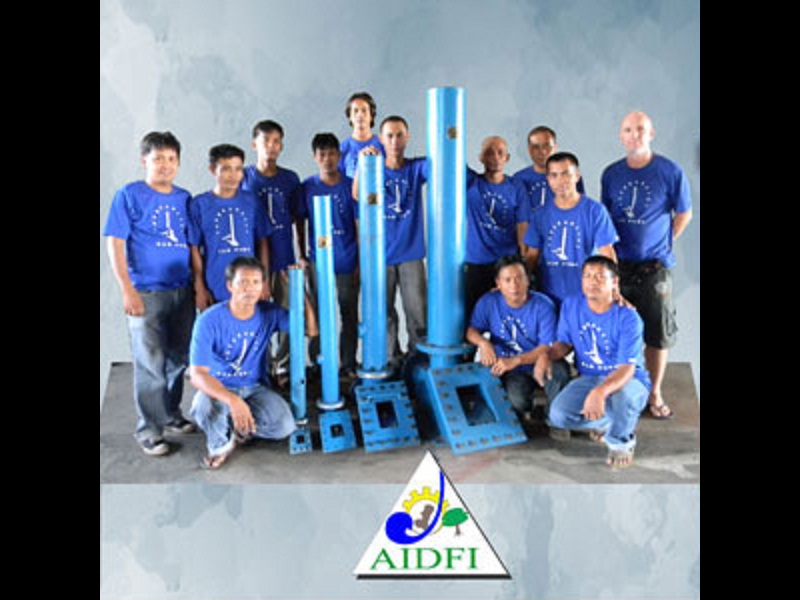 His work had taken Dutch marine engineer Auke Idzenga to places that were literally high and dry, mainly the uplands of Negros. When he first got there in the late 1990s, the closest water source was hundreds of meters away from the poor villages, often requiring a trek down treacherous ravines.
But Idzenga had since led a group that not only overcame gravity but also cynicism and racial divides.
The group equipped the mountain settlements with the hydraulic ram pump, an old, nearly forgotten technology capable of bringing a steady water supply to elevated areas using only the raw power of a rushing river or stream.
Everywhere he went at the beginning of his mission, the tall and lanky Caucasian often drew curious stares from the villagers.
“But when I began talking in Ilonggo, I blended in immediately,” said Idzenga, co-founder of the Philippine-based Alternative Indigenous Development Foundation Inc. (AIDFI), one of this year’s recipients of the Ramon Magsaysay Award.
Considered the Asian equivalent of the Nobel Prize, the award is being given to AIDFI (the lone recipient from the Philippines this year), as well as to five individual honorees from Indonesia, India, and Cambodia. The awarding ceremony is set on August 31 at the Cultural Center of the Philippines.
Filipino at heart
He hailed from Holland, but the 49-year-old Idzenga said he had become a Filipino at heart, more so after he married Susan, a Negrense. Like him, their four children speak fluent Ilonggo; “no Dutch or English” spoken in their Bacolod home, he said.
“When I talk, I don’t look at myself and I don’t see my kulay (skin color),” Idzenga said. “I look at myself as an internationalist, but my heart is with the Filipinos.”
AIDFI’s development work has so far centered on promoting the ram pump, but Idzenga and the group’s 20 full-time Filipino members are also developing other self-sustaining technologies, such as one that processes lemon grass into essential oils.
AIDFI was formed in 1991 by a group of activists led by union organizer Leonidas Baterna, who shared his dreams of an “integral and liberating development” with Idzenga.
Their partnership was forged against a backdrop of social turmoil that accompanied the collapse of the sugar industry in Negros in the 1980s. Hundreds of workers and farmers were then displaced, their families sinking deeper into poverty and hunger.
Distrust, suspicion
AIDFI sought to address the basic needs of the affected farmers through agricultural production and technology development. But lack of funds and the loss of key members forced the organization to close shop after only a few years.
Idzenga said this was partly due to the distrust and suspicion among the upland villagers toward non-governmental organizations (NGOs) like AIDFI.
“We had to work really hard for funding because of the bad name NGOs got especially in Negros. In the 1980s when the programs were not implemented well, there were so many NGOs that mushroomed,” he said. “We worked without funding for many years. And there was no government support.”
At that point, returning from a brief visit to his native Holland, Idzenga worked to revive AIDFI, this time giving the group a much clearer focus on rural technology. He came up with his own design of the ram pump and had it patented.
The ram pump uses the natural kinetic energy of flowing water from rivers or springs to push water uphill, without relying on gas or electricity.
The “reinvented” pump introduced by the AIFPI to the Negros uplands can bring water to an elevated reservoir at 1,500 to 72,000 liters per day, according to Idzenga.
Social package
The pump itself accounts for only 10 percent of the cost of the entire “social package” the group brings to the community that would avail itself of the technology.
The package also includes community consultation and technical training, ownership transfer, and the setup of local associations that would manage the water generation and distribution system, as well as financing.
AIDFI also receives donations or grants from businesses, banks and the government, Idzenga said. For example, “we’re talking with Coca-Cola about producing 50 ram pumps a year and they would be paying for them,” he said.
“Landbank is now picking up the technology and offering it to municipalities through loans. We also get some money from the Department of Agriculture for research,” he added.
While most of its projects are in Negros, up to 180 AIDFI initiatives have taken root across the Philippines. The group also managed to set up projects in Cambodia, Afghanistan, Nepal, Malaysia, East Timor, Costa Rica, Peru and even First World countries like Japan and France.
Idzenga said the introduction of the ram pump often became the “triggering point” for development in the communities, like in the case of Sitio Anangue in Murcia, Negros Occidental.
The small village remained poor despite being placed under land reform in the 1980s, he recalled. “The road was very bad. It was very hard for the villagers to cultivate the land. There were no facilities and the community was not organized. They were very much like on survival mode; it was just everybody for himself and there was occasional conflict.”
Organized for first time
“Then we came in with the ram pump,” Idzenga said. “It was the first time the community had any organization of any sort. We completely organized the water association.”
“Then from one village, we got a request from the neighboring village. Then there was a third. So it became three sitios. There’s more cooperation because water came from the same place,” he said.
And soon, the water association in Anangue started exploring other development projects, he said. With the households paying P30 per month for the water, the community found itself with enough funds to go into hog raising and cash crops.
“In the past, this kind of thing never happened in the community. Now they have started cooperating. Now they start thinking of further development,” he said.
City dwellers tend to take water for granted, he said. But in the uplands, “you have to imagine how the people have to go down 80 meters (to fetch water), every day. Try it yourself and carry 40 liters of water on your back.”
“Sometimes kids missed classes because whenever their parents went down to fetch water, the kids would just end up playing and forget about school,” Idzenga said.
Affectionate people
Idzenga said he was drawn to the Philippines as a young man of 22, after hearing many stories about the country when he was still working as a seafarer.
After two decades of living in the Philippines with his family, he said, “I don’t know the difference anymore between living here and in Holland. Everything here is normal for me now.”
Filipinos, Idzenga said, are an affectionate people. “The first thing they do is look at the color (of my skin), but then when we start talking, they warm up and connect. They keep on coming back to talk. It becomes a friendship. Very warm.”
Because of this connection, he said, he had taken great pride in improving the lives of the country’s poorest, especially in places hardly reached by government services.
“The fact that we can bring up water at such volumes for every family, and they don’t have to go down the mountain anymore, that’s a huge, unbelievable transformation,” Idzenga said.
The Ramon Magsaysay Award, Idzenga said, would give his organization a bigger voice for its advocacy. “It fits in our highest objective, which is to spread the (ram pump) technology all over the world. Winning this award will help us reach more villages,” he said.
Monday, August 1, 2011
PCCI hits focus on renewable energy
Says PH needs baseload plants, lower power rates
By: Abigail L. HoPhilippine Daily Inquirer
9:31 pm | Sunday, July 31st, 2011

PCCI: Bring electricity prices down first before burdening consumers again with FIT rates for renewable energy projects.
PCCI energy committee chairman Jose Alejandro said power rates were expected to increase even more next year due to the expiration of the transition supply contracts (TSCs) attached to the privatized plants and independent power producer (IPP) contracts of National Power Corp.
“Can we expect that the new contracts that will be negotiated will have lower rates than the old TSCs? Of course not. We expect the new rates to be higher,” Alejandro said in an interview Friday.
These would be further exacerbated by petitions by Power Sector Assets and Liabilities Management Corp. for the universal charge, as well as the generation rate adjustment mechanism (GRAM) and the incremental currency exchange rate adjustment (Icera), automatic adjustments that could move rates either up or down.
The introduction of the FIT rates for renewable energy projects would add another burden to consumers and businesses, Alejandro said, making the country even less competitive on the global stage.
“We’re already charging too high for power. It would have been okay if we were just one or two centavos higher than our neighbors, but our rates are double or even triple those of other countries in the region. We can’t have any more increases,” Alejandro said, referring mainly to the FIT rates.
The FIT scheme assures renewable energy developers of future cash flow as electricity end-users will be charged fixed amounts to cover the production of energy from renewable sources.
Payment for the use of clean energy will come from a uniform per-kilowatt-hour charge, dubbed FIT Allowance (FIT-All), which will be collected from all electricity end-users.
The National Renewable Energy Board recently approved a FIT rate of 12.75 centavos a kWh for renewable energy projects. This universal levy would be borne by all power users by 2014, when all expected renewable energy projects would have already gone on line.
Instead of pushing to get renewable energy projects on line, Alejandro said the government should focus on getting more commitments for additional baseload generation capacity.
At this point, Alejandro said, the country already had enough renewable energy capacity from its numerous hydro and geothermal installations. Some projects such as biomass and mini-hydro could be installed in off-grid areas. Solar and wind, however, should take a backseat—at least for the next three to five years.
“Our priority should be building baseload and reserve capacity and bringing power rates down. We need sustainable, reliable power supply. We don’t need [renewable energy] now. It’s not reliable, it’s not controllable, and it’s very costly,” Alejandro said.
“It will be counterproductive for the country to focus on [renewable energy]. Let the technologies mature first, but in other countries, not here. We can still catch up, especially when the technologies become much cheaper to install,” Alejandro added.
Subscribe to:
Posts (Atom)